

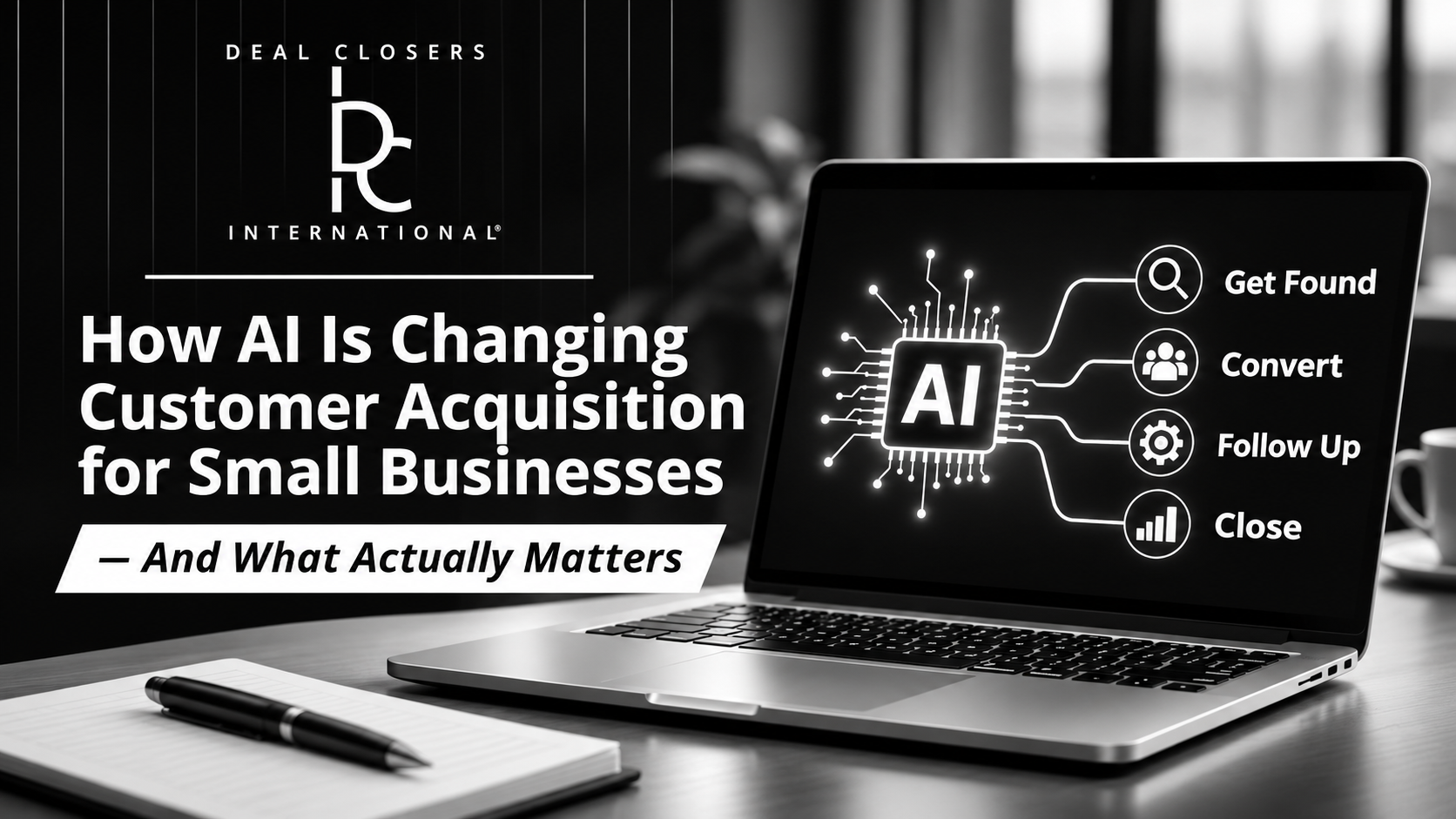
AI customer acquisition is changing how small businesses attract prospects, follow up with leads, and turn more opportunities into paying customers. Artificial intelligence is changing the way businesses find customers, respond to enquiries and manage sales opportunities.
But there’s an important distinction between using AI and using AI effectively.
Installing a chatbot, generating social media content or purchasing another software subscription doesn’t automatically create more customers.
The real opportunity comes from using AI to improve the entire customer acquisition process.
For small and medium-sized businesses, that means being easier to find, responding to potential customers faster, following up more consistently and converting more opportunities into paying customers.
1. How AI Customer Acquisition Is Changing the Way Customers Find Businesses
For years, businesses have relied on traditional search engines, referrals, advertising and social media to attract customers.
Those channels still matter. But AI-powered search and recommendation tools are becoming another way potential customers discover products, services and providers.
Instead of searching through multiple websites, a customer might ask an AI assistant:
- Who provides commercial roofing services in my area?
- What should I look for when hiring an IT support company?
- Which businesses can help improve my sales follow-up?
- What questions should I ask before choosing a contractor?
Businesses need clear, accurate and useful information online so both potential customers and discovery platforms can understand what they offer.
This makes website quality, service descriptions, credibility and useful educational content increasingly important.
AI visibility should complement traditional SEO, not replace it. Google’s guidance on AI features in Search confirms that established SEO best practices remain relevant to AI-powered search experiences.
2. Faster Responses Can Prevent Lost Opportunities
Consider a typical service business.
A potential customer visits the website and requests a quote.
The enquiry arrives while the owner is on a job site, the office is busy or the sales representative is meeting another customer.
Several hours pass before anyone responds.
By then, the prospect may have contacted another provider.
AI-assisted automation can help reduce that delay by acknowledging the enquiry, collecting relevant details and alerting the right person.
For example, a roofing company could automatically acknowledge a new estimate request, collect the property’s location and type of work required, and notify the estimator.
That doesn’t mean AI should provide an unverified price or replace a professional inspection.
It means the business can respond promptly and move the enquiry toward the next appropriate step.
3. AI Can Support Consistent Sales Follow-Up
Many businesses spend money generating enquiries but don’t have a reliable process for following up.
An estimate is sent. A prospective customer says they’ll think about it. A meeting gets postponed.
Then everyone gets busy.
The opportunity gradually disappears.
A well-configured CRM and automation system can help identify which prospects need attention, remind employees about outstanding estimates and trigger appropriate follow-up messages.
AI can assist by summarizing conversations, helping prepare personalized responses and identifying information that still needs to be collected.
However, automated communication needs boundaries. Messages should be accurate, relevant and compliant with applicable consent and privacy requirements.
The objective isn’t to send more messages.
It’s to make sure worthwhile opportunities aren’t forgotten.
4. AI Can Help Businesses Prioritize Better Opportunities
Not every enquiry has the same potential value.
A business may receive ten requests for small one-time jobs and one enquiry about a substantial commercial contract.
Treating every opportunity identically can mean spending valuable sales time in the wrong places.
AI-assisted tools can help organize enquiries using information such as service requirements, location, project size, urgency and customer fit.
The business can then prioritize conversations that warrant immediate personal attention.
But an automated score should support human judgment, not replace it.
The goal is to identify which opportunities deserve attention and ensure someone takes the appropriate action.
5. AI Cannot Fix a Broken Sales Process by Itself
This is where many businesses make an expensive mistake.
They assume adding technology will solve an underlying operational problem.
But consider these situations:
- More website traffic won’t help much if visitors cannot understand the offer.
- More enquiries won’t help if nobody follows up.
- Automated reminders won’t help if the sales team ignores them.
- A chatbot won’t close a complicated commercial opportunity that requires a knowledgeable salesperson.
- Better reporting won’t generate revenue unless someone acts on the findings.
AI works best when it’s supporting a clearly defined business process.
Before implementing new tools, a business should understand how customers currently find it, where opportunities are being lost and what would produce the greatest improvement.
6. Start With the Customer Acquisition System
At Deal Closers International, we approach customer acquisition as four connected stages.
Get Found
Help potential customers discover the business through search, AI-powered discovery, referrals and targeted marketing.
Convert
Turn that attention into qualified enquiries through clear messaging, useful websites and effective lead capture.
Follow Up
Use CRM systems, automation and consistent communication to keep opportunities moving.
Close
Help qualified prospects make informed decisions through meaningful conversations, effective sales processes and appropriate next steps.
AI can support each stage.
But its value should ultimately be measured by business outcomes, not the number of automated tasks performed.
7. What Should a Small Business Automate First?
Rather than implementing everything at once, start with a practical assessment.
Ask these five questions:
- How quickly do we respond when a potential customer contacts us?
- Do we know which estimates and enquiries are waiting for follow-up?
- Can we identify where our best customers are coming from?
- Are our salespeople spending enough time on qualified opportunities?
- Can we measure how many enquiries become paying customers?
The answers can reveal opportunities to improve performance without immediately increasing advertising spending.
In many cases, improving how existing opportunities are handled is a more sensible first investment than purchasing additional traffic.
The Bottom Line
AI isn’t a customer acquisition strategy on its own.
It’s a collection of tools that can help businesses execute a strategy more efficiently.
The businesses that benefit most will be those that combine useful technology with clear processes, reliable follow-up and strong customer relationships.
The objective isn’t to automate everything.
It’s to make it easier for the right customers to find your business, receive the attention they need and confidently choose to work with you.
Find Out Where Your Business Is Losing Customers
At Deal Closers International, we help businesses identify and improve the gaps between getting found, converting interest, following up and closing customers.
Our complimentary Customer Acquisition Review examines your search visibility, website conversion, lead capture and sales follow-up process.
We’ll identify where opportunities may be getting lost and explain what we’d prioritize improving first.
Request Your Free Customer Acquisition Review
Deal Closers International — Turn More Opportunities Into Customers.