

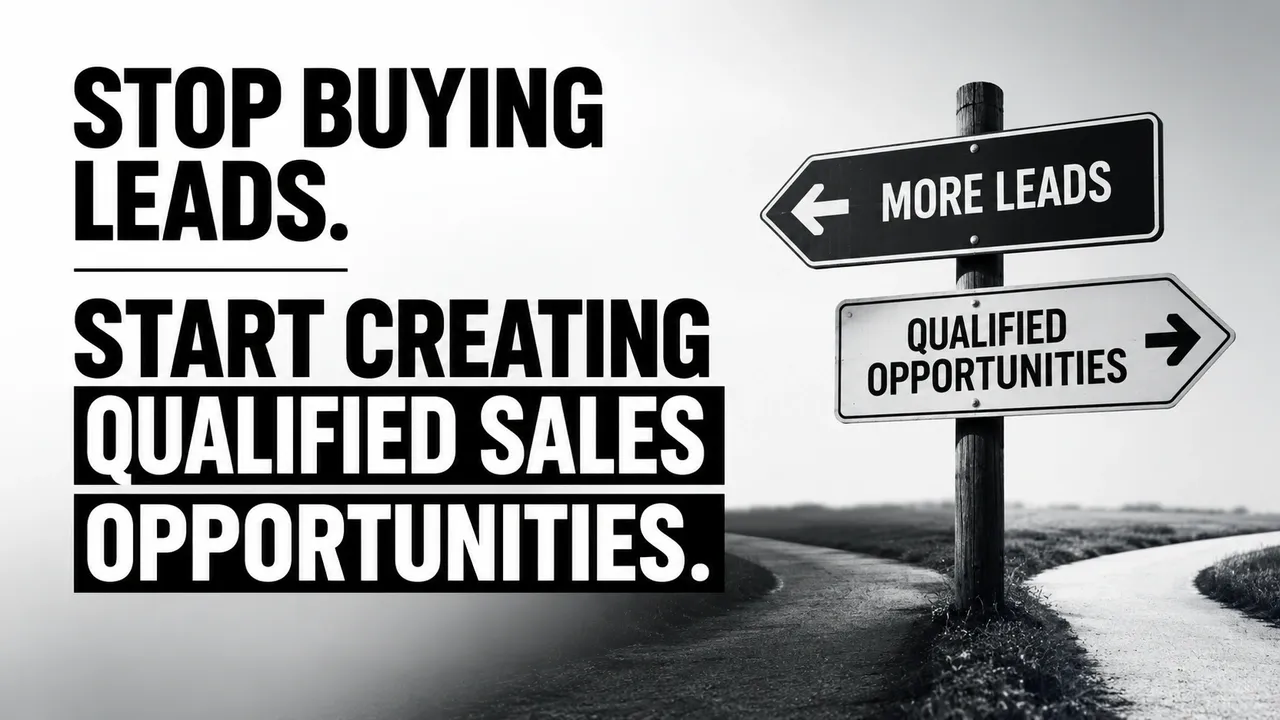
A lot of businesses say they need more leads.
Generating qualified sales opportunities is more valuable than simply increasing lead volume. Businesses need prospects who fit their target market, have a relevant need, and are willing to engage in a meaningful sales conversation. Without proper qualification, more leads can mean more wasted time and higher customer acquisition costs.
But leads aren’t really what they need.
They need more opportunities to win customers.
Those two things sound similar, but they can produce very different results.
A company can buy hundreds of leads and still struggle to generate revenue. It can receive website inquiries that never answer the phone, purchase lists filled with businesses that have no reason to buy, or book appointments with people who aren’t actually decision-makers.
On paper, the marketing numbers can look good.
The sales pipeline tells a different story.
The problem is that lead generation is often measured too early in the customer-acquisition process.
A name, phone number, email address or form submission might be a lead. But it doesn’t become a meaningful sales opportunity until there is enough fit, interest and access to justify a real sales conversation.
Businesses don’t make money when a lead enters a spreadsheet.
They make money when the right prospect moves through a sales process and becomes a customer.
What Is a Lead?
At its simplest, a lead is someone—or some business—that could potentially become a customer.
That definition covers a huge range of quality.
A homeowner who submitted a request for an HVAC replacement could be a lead.
Someone who downloaded a guide six months ago could be a lead.
A commercial property manager identified through prospecting could be a lead.
A list containing 500 businesses in your target market could technically contain hundreds of leads.
But none of those things automatically means there is a real opportunity to make a sale.
That’s where businesses can get trapped by volume.
If the objective becomes generating the largest possible number of leads at the lowest possible cost, it becomes very easy to optimize for the wrong number.
More leads do not necessarily mean more revenue.
What Makes a Sales Opportunity Qualified?
A qualified sales opportunity is further down the customer-acquisition process.
The exact definition will vary by business, but several things usually need to be true.
The prospect should fit the type of customer the company actually wants.
There should be a legitimate current or potential reason for the prospect to consider the service.
The conversation should involve a decision-maker or someone who can materially influence the decision.
And there should be a reasonable next step in the sales process.
For a residential contractor, that might mean a homeowner in the correct service area who is considering a project the contractor actually wants.
For a commercial cleaning company, it might mean a facility manager, business owner or property manager who is willing to discuss their cleaning requirements and potentially schedule a walkthrough.
For another B2B company, it could mean reaching the right executive and discovering a business problem the company can actually solve.
That is very different from simply collecting contact information.
The Customer-Acquisition Chain
Instead of thinking only about lead generation, businesses should look at the entire path that produces revenue:
Target Market → Right Decision-Maker → Relevant Need → Conversation → Qualified Opportunity → Sales Process → Customer
Every stage matters.
If you target the wrong market, everything downstream becomes harder.
If you reach the right company but the wrong person, the opportunity can stall.
If there is no relevant need, there may be nothing to sell.
If the prospect never enters a real conversation, there is no meaningful sales process.
And even a great opportunity can still be lost if the business doesn’t follow up, present value effectively or ask for the sale.
Generating qualified opportunities is only the beginning. Businesses also need a reliable sales lead follow-up process to turn those opportunities into paying customers.
This is why customer acquisition should be treated as a system, not simply a marketing campaign.
Cheap Leads Can Become Expensive
Businesses understandably pay attention to cost per lead.
They should.
But cost per lead without context can be misleading.
Imagine one campaign produces 100 leads for $20 each.
Another produces 25 opportunities for $60 each.
At first glance, the $20 leads look significantly better.
But what happens next?
If only five of those 100 leads become legitimate sales conversations, the company effectively spent $400 for each conversation.
If 15 of the 25 higher-quality opportunities become legitimate sales conversations, the economics look completely different.
And ultimately, neither number matters as much as what happens further down the funnel:
How many opportunities became proposals?
How many proposals became customers?
How much revenue did those customers produce?
That’s where acquisition performance becomes commercially meaningful.
An Appointment Isn’t Automatically an Opportunity Either
The same principle applies to appointment setting.
Putting something on a calendar is not the objective.
A business can fill its calendar with meetings that never had a realistic chance of becoming customers.
If the prospect is outside the target market, doesn’t understand why the meeting was booked, has no relevant need, or has no authority over the decision, the appointment may have very little value.
A smaller number of properly qualified conversations can be worth considerably more than a calendar filled with weak appointments.
That means appointment-setting performance shouldn’t simply be measured by appointments booked.
Businesses should also understand appointments held, qualified opportunities created, proposals generated, customers acquired and revenue produced.
Measure the Funnel That Actually Produces Revenue
A useful customer-acquisition system should make it possible to see where opportunities are being created—and where they are being lost.
Depending on the business, that could mean tracking:
Prospects Targeted → Contacts Attempted → Conversations → Qualified Opportunities → Appointments/Estimates → Proposals → Customers → Revenue
Once those numbers are visible, better questions become possible.
Are we targeting the right businesses?
Are we reaching decision-makers?
Are prospects agreeing to conversations?
Are appointments actually happening?
Are qualified opportunities becoming proposals?
Are proposals being followed up properly?
Are we closing enough of them?
Suddenly, “we need more leads” becomes a much more useful business discussion.
Sometimes the answer really is more lead volume.
Sometimes the company needs better targeting.
Sometimes it needs faster follow-up.
Sometimes it needs stronger qualification.
Sometimes the biggest problem is what happens after the opportunity reaches the salesperson.
You can’t know which problem you have if everything is simply being measured as “leads.”
Stop Buying Activity. Build Customer Acquisition.
The goal of marketing and prospecting shouldn’t be to generate impressive activity numbers.
The goal is to create opportunities that can become customers.
That requires looking beyond the top of the funnel and understanding the entire acquisition process—from identifying the right market to converting opportunities into revenue.
At Deal Closers International, that’s how we think about customer acquisition:
Get Found → Convert → Follow Up → Close.
Because getting attention is only the beginning.
The real value comes from building a system that consistently turns the right opportunities into customers.
Are you generating leads but struggling to turn them into qualified sales opportunities? Deal Closers International can help identify where your customer acquisition process is losing potential revenue. Request your complimentary Customer Acquisition Review to discover where improvements could produce better results.